Screen Time Personality Quiz
Discover Your Pathway to Digital Peace.
TAKE THE QUIZ

Guide to
Grayscale
MAKE YOUR PHONE LESS ADDICTIVE IN SECONDS.
DOWNLOAD


DOWNLOAD
Your screen can become a tool for encouragement.
Wallpapers for Desktop & Phone
Hey, I’m Julianne!
Christian Coach, encourager, digital distraction disruptor. I help people reduce their screen time, build life-giving habits, and stay focused on what matters most. The digital world isn’t going away, but your distraction can. So glad you’re here!

Welcome!


TELL ME MORE
Block Distracting Apps With One Quick Tap
Meet The Brick
March 10, 2026
59 | How to Use Your Camera Roll for the Examen Prayer and Grow in Gratitude
You likely have thousands of photos on your phone right now. A family gathering. A moment from a trip. A screenshot of something that encouraged you. A foodie picture or a quiet scene you captured because something about it felt worth holding onto.
You probably scroll past most of them without thinking twice.
But here is what I want you to consider: what if those photos are not just memories? What if your camera roll is actually one of the most honest records of God’s faithfulness in your life?
I love this idea because I spend a lot of time talking about how our phones pull us away from God and that is very real, but today I want to flip the script.
Your phone can actually draw you closer to God when you use it with intention, even the most ordinary features can become something sacred. Today I want to show you one specific way to do exactly that, by pairing your camera roll with one of the oldest prayer practices in Christian history.
What Is the Examen Prayer?
The Examen is a spiritual practice developed by Ignatius of Loyola in the 16th century. Before you let the history intimidate you, here is what you need to know: the concept is beautifully, almost deceptively, simple.
You slow down. You look back and you pay attention.
Ask yourself the question, “Where was God at work in my life during this season?” And then you bring whatever surfaces, the gratitude, grief, the regret, and joy, straight to God. That is it. That is the whole thing.
The Examen is not a performance review. It is not about tallying your spiritual wins and losses or producing the right feelings on cue. It is about learning to see your own life through spiritual eyes. To notice what you rushed past and receive what you may have forgotten to be grateful for. To make space for the things you never quite stopped to grieve.
In its traditional form, Ignatius laid the Examen out in five movements: become aware of God’s presence, review the day with gratitude, pay attention to your emotions, choose one feature of the day and pray from it, and look toward tomorrow. Our camera roll adaptation stays true to the heart of those movements, while meeting you exactly where you are with your phone in hand, and ten minutes to spare.
Why Your Memory Works Against You in Prayer
Here is something I hear over and over from people who try the Examen: they sit down to reflect and their mind goes completely blank. They genuinely cannot recall what happened three weeks ago as sometimes the days blur together, and the hard things stick while the good ones quietly slip away.
Our brains are wired to hold onto pain more tightly than joy, because pain signals danger and the brain’s first job is to keep us safe. Psychologists call this the negativity bias. Left to our own devices, we will almost always carry a lopsided view of our own lives, heavier on the hard stuff, lighter on the blessings.
Your camera roll tells a different story.
Think about what is actually in your photos. Not just the curated, posed ones. All of it. The candid moments from an ordinary Tuesday. The screenshot of a verse that hit you at just the right time. A meal with people you love. A child’s face mid-laugh. A quiet corner of somewhere that mattered. Your camera roll is an unfiltered, chronological record of your actual life, and it holds onto things your memory has already let go of.
When you use it prayerfully and with intention as part of the Examen, it becomes exactly the kind of evidence your heart needs to practice gratitude that is real, not manufactured.
How to Pray the Examen Using Your Camera Roll
This practice takes about 15 to 20 minutes. You can do it at the end of a week, a month, a season, or honestly any time you feel like you need to take stock of where you have been.
Step 1: Create Space and Open in Prayer
Find a quiet spot and put your phone face down for just a moment first. Take a breath and say a simple prayer before you begin. Something like this: “Holy Spirit, show me where you have been at work in my life. Give me eyes to see.”
That one sentence changes everything. You are not scrolling mindlessly, rather asking God to guide your attention and that is an act of worship before you ever look at a single photo.
Step 2: Scroll Slowly and Chronologically
Open your photos app and use the monthly or “by date” view so you can move through your images in order. Start at the beginning of whatever time period you are reviewing. Then scroll slowly.
Resist the urge to skim. The temptation will be strong, especially if you have hundreds of photos however the point is to linger. Let the photos bring moments and memories back to the surface. Let your mind catch up with your life.
Step 3: Look for These Three Things
As you scroll, you are not just browsing. You are looking for something specific.
Gratitude. When you land on a photo that brings something warm up in you, a forgotten memory, a moment of connection, a small gift you had already moved past, pause there. Let yourself feel it. Say thank you, out loud or in your heart. You might jot a quick note in a journal if something significant surfaces. The goal is to let the evidence lead you to gratitude. The photos do the work of reminding you what is actually true about your life.
Confession. You will also scroll past photos that bring up something heavier perhaps a season that was harder than you let yourself admit. A memory where you were not your best self. You lost your patience. You pulled away when someone needed you to lean in. When those come up, do not rush past them. Pause. Be honest. Bring it to God. Lord, I am sorry for that. Please forgive me. Then, and this part really matters, receive the forgiveness and keep going. No spiraling. Acknowledge, release, move forward.
Grief. This one surprises people, but stay with me. As you scroll, you will notice the absences. The person who is no longer in the pictures. The home you had to leave. The friendship that quietly changed. The season of life that ended before you fully realized it was ending.
Grief belongs in the Examen. So much of the weight we carry comes from losses we never stopped to acknowledge, because life kept moving and we moved with it. When you hit those absences, let yourself feel them. Tell God about it. You do not need the right words. Just sit with it for a moment and let Him meet you there.
Step 4: Look Forward Before You Close
This movement is too important to skip. Before you put your phone down, turn your eyes toward tomorrow. Ask God: “given what I just noticed, what do I need from you? Where do I need your help?”
It does not have to be a long prayer. Even one sentence is enough. This is what makes the Examen a prayer and not just a journaling exercise. You are not leaving the practice in the past. You are stepping into tomorrow with intention and with God.
Step 5: Close in Stillness
Put your phone down and spend a few minutes being still and ask yourself, What stood out? What surprised you? Where did you see God? Write it down if you can, even just a sentence or two and afterwards close with a simple prayer of gratitude for the season, the lessons, and the God who was in all of it, even the hard parts.
Your Camera Roll Is a Record of Grace
You did not need a retreat center for this practice. You did not need a spiritual director, a workbook, or a two-hour block of time rather you needed your phone, 15 to 20 minutes, and a willingness to pay attention to your own story.
Thousands of photos are sitting on your phone right now. Each one captures a moment God was present. A moment He provided, protected, surprised, or simply showed up in the ordinary details of your daily life.
Your camera roll has been waiting for you to see it that way.
The Examen is not complicated because it does not require more time than you have. It just requires a willingness to pay attention to your own story and to the God who has been writing it all along.
This week, try it. Set aside the time, open your photos, and pray: “Holy Spirit, show me where you have been.” I think you will be surprised by what He shows you.
Ready to Use Your Phone with More Intention Every Day?
If this practice stirred something in you, here is what I want you to know: using your phone with intention is a skill you can actually learn and your phone already has a built-in feature designed to help you do exactly that.
It is called Focus Modes, and most people have never touched it.
Focus Modes Made Simple is a one-hour workshop where I walk you through every step of setting up Focus Modes on your smartphone, whether you are on iPhone or Android. You’ll go from constantly checking your phone to confidently customizing your phone’s Focus Modes that protect your time and guard your attention, so you can support your spiritual rhythms and help you stay fully present in the moments that matter.
This is not a complicated tech tutorial. It is a practical, faith-rooted workshop that helps your phone work for your spiritual rhythms instead of against them. The same intentionality you bring to the Examen, paying attention, creating space, protecting what matters, you can build right into how your phone operates every single day.
Inside the workshop you will receive:
- A personal planning workbook
- A gallery of 40 digital phone wallpapers for your lock screen
- Step-by-Step written iphone & Android instructions
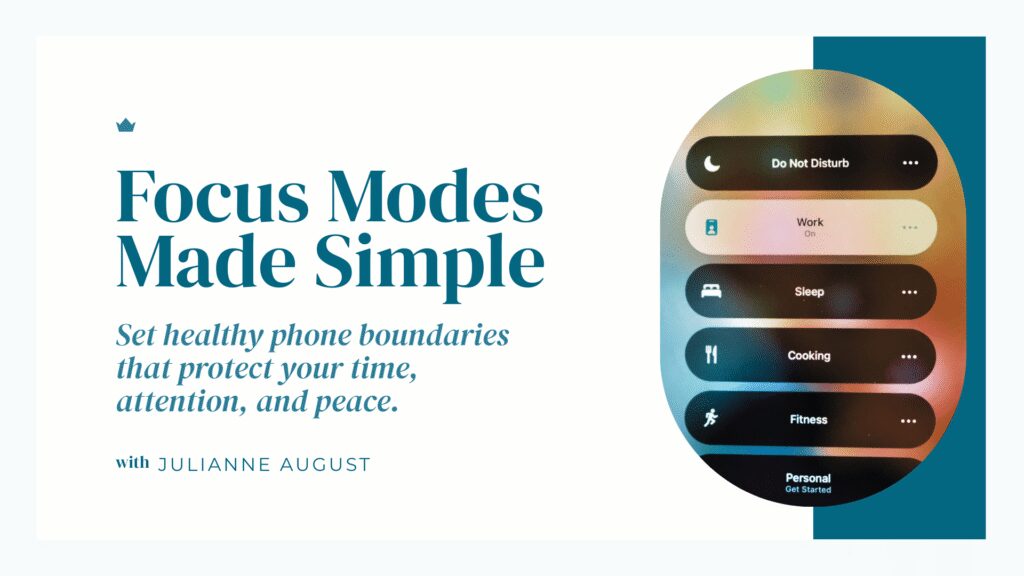
Join the workshop at Focus Modes Made Simple Workshop. I would love to see you improve your focus!
FAQ’s About the Examen Prayer
Do I need to be Catholic to practice the Examen? Not at all. While the Examen originated in the Catholic tradition through Ignatius of Loyola, Christians across denominations have used it for centuries. It is simply a structured way to slow down and notice God in your daily life. If you love Jesus and want to pay better attention to where He is showing up, the Examen is for you.
What if I feel nothing when I scroll through my photos? That is okay. Start by simply noticing. You do not have to manufacture emotion. Sometimes just identifying the facts, “here is a moment God provided,” or “here is a day I was not alone,” is enough to begin reorienting your heart toward gratitude. With the Examen, the feeling often follows the practice, not the other way around. Give yourself grace and keep going.
How does this connect to overcoming digital distraction? The Examen reclaims your camera roll from passive scrolling and turns it into active, prayerful reflection. Instead of consuming content mindlessly, you are using your phone as a tool for presence, faith, and awareness which is at the heart of digital wellness: not eliminating your phone, but learning to use it with intention. Your phone is not the enemy. Purposeless phone use is.
How often should I practice the Examen? Ignatius himself practiced the Examen twice daily, but do not let that pressure you. Even a monthly practice using your camera roll can produce real spiritual fruit. Start wherever you are, once a week, once a month, at the end of a season, and let it grow from there. Consistency matters far more than frequency right now.
Leave a Review
Has the podcast helped you create healthier habits?
If you’ve learned something that’s making a real difference in your life, I’d love to hear about it! Your review not only encourages me but also helps others find this podcast and start their own journey to overcome digital distractions. I read every single one and truly appreciate your support!
WRITE A REVIEW ➞


TAKE THE QUIZ ➞
Learn to declutter your digital life, set healthy boundaries, and create spaces of rest.
Ever wonder what’s really fueling your screen habits? This quiz will help you find out! It’s quick, fun, and packed with insights to help you tackle distractions head-on. Your results will show you exactly where to start.
Take the free
Screen Time Personality Quiz!
GET THE FREE GUIDE ➞
The Simple Step to Reduce Screen Time
Imagine your phone fading into the background and notifications no longer grabbing your attention, social media feeling less tempting, and your mind finally free to focus on what truly matters. That’s the power of grayscale. It’s a simple but powerful shift.
Make Your Phone Less Addictive in Seconds
Your Guide to Grayscale will help you experience it for yourself!


DOWNLOAD ➞
Grab the encouraging
wallpapers for phone and desktop.
From uplifting Bible verses to truth-filled identity reminders, and even just-for-fun designs, these wallpapers are a great way to stay grounded throughout your day. Choose from 8 desktop and 8 phone designs.

MEET THE BRICK ➞
What if there was an actual wall between you and digital distraction? Not another screen time limit you can easily ignore, but a physical barrier that makes mindless scrolling nearly impossible. After 30 days of testing, I've found the tool that finally works: The Brick.
