Screen Time Personality Quiz
Discover Your Pathway to Digital Peace.
TAKE THE QUIZ

Guide to
Grayscale
MAKE YOUR PHONE LESS ADDICTIVE IN SECONDS.
DOWNLOAD


DOWNLOAD
Your screen can become a tool for encouragement.
Wallpapers for Desktop & Phone
Hey, I’m Julianne!
Christian Coach, encourager, digital distraction disruptor. I help people reduce their screen time, build life-giving habits, and stay focused on what matters most. The digital world isn’t going away, but your distraction can. So glad you’re here!

Welcome!

TELL ME MORE
Block Distracting Apps With One Quick Tap
Meet The Brick
June 9, 2026
Is Divided Attention Between Two Screens Making You Tired, Distracted, and Half-Present? Learn How to Take Back Your Focus
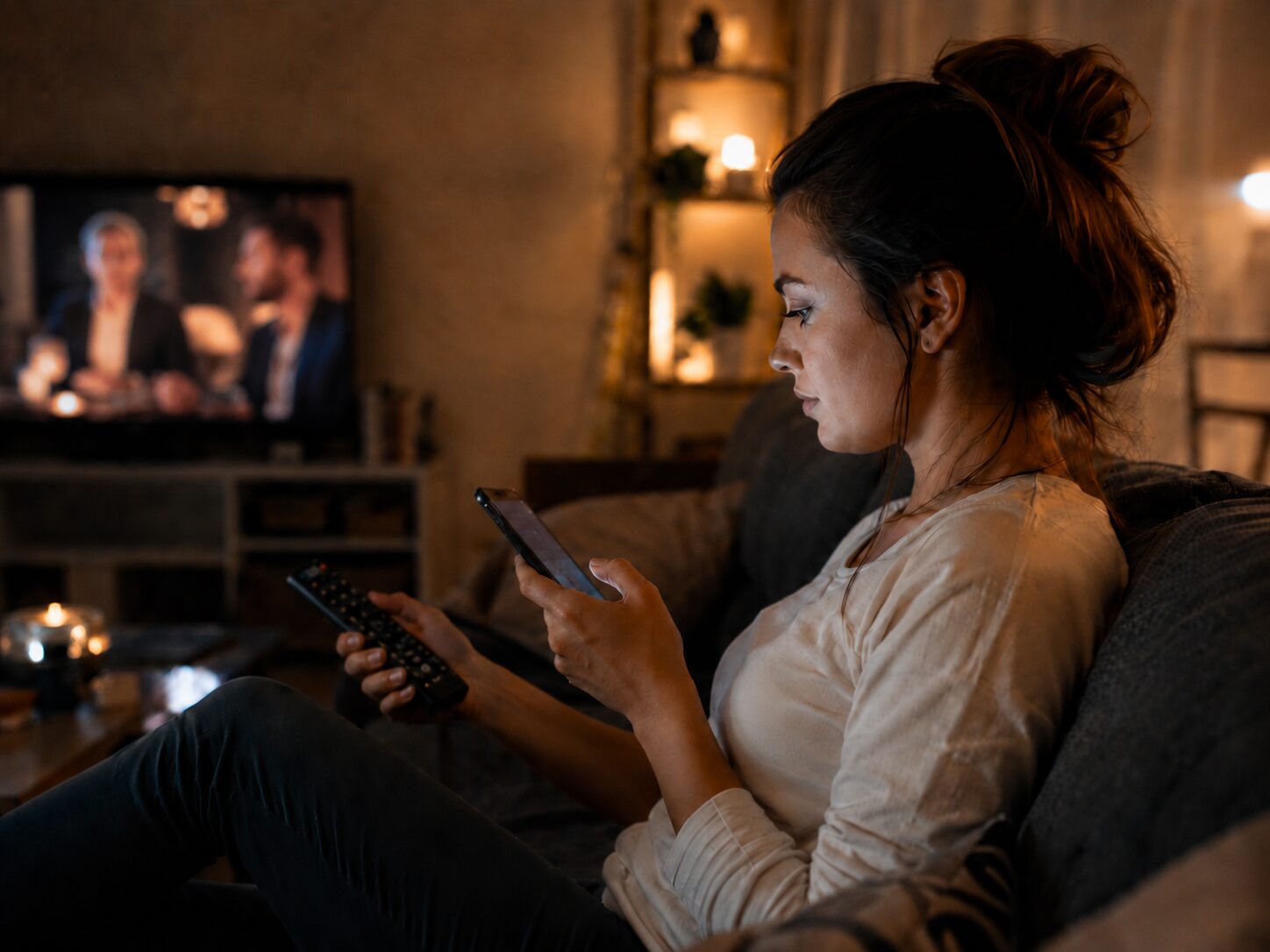
You finally sit down. The show you have been meaning to watch is on, you have your blanket, and for a few minutes you are completely present. Then, without deciding to, your phone is in your hand. You are half-watching, half-scrolling, glancing up at the screen and back down again. By the time the episode ends, you cannot quite remember what happened in the middle. And even though you just spent an hour on the couch, you do not feel rested.
Sound familiar? What you are experiencing is divided attention and it is quietly costing you more than you realize.
What Divided Attention Actually Means
Divided attention is not just a focus problem. It is what happens when your brain tries to process two streams of input at the same time. And despite what we like to tell ourselves, it cannot actually do it.
Science is clear on this. What feels like multitasking is really your brain switching rapidly back and forth between two things. Every single switch carries a cost in mental energy, in comprehension, and in how present you actually feel. If you want to go deeper on this, I talked all about task switching in podcast episode 68, and it is worth a listen.
The specific version of divided attention we are talking about here is two screens at once. Phone in hand while the TV is on. Scrolling while you are on a phone call. Laptop open while Netflix runs in the background. None of these feel like a big deal in the moment. That is exactly the problem.
What Two Screens Are Costing You
Most of us have never stopped to think about what divided attention between two screens is actually taking from us. Here are three things worth talking about.
Your rest is not real rest when your brain is toggling
We reach for our phones while watching TV because we think we are relaxing. But your brain does not get to rest when it is managing two inputs simultaneously. You end the evening having watched a show and scrolled a feed, and you feel vaguely unsatisfied and not quite rested. Your brain never got to settle into one thing. It was toggling the whole time, and that fatigue is real.
Your enjoyment disappears when your attention is split
You were genuinely looking forward to watching something. But once the phone comes out, you are only present for the parts your eyes happen to catch. The rest becomes background noise. That is a strange thing to do to yourself, especially when you chose to sit down and watch it in the first place.
Your presence is the price the people in your life pay
This one matters most. If you are on a call with someone and scrolling at the same time, they are getting a portion of you. You might be hearing the words, but you are not really listening. The people who know us well can often tell. There is a quality of attention that comes through even on a phone call, and divided attention dilutes it in ways we do not always realise we are doing.
Full attention is a form of love. When you give someone or something your whole focus, you are honouring what is right in front of you.
The One-Screen Habit
So what do you actually do about it? The practice is simple. It is what I call the one-screen habit: whatever screen you are looking at, that is the only screen you are looking at.
One screen at a time. That is it.
Simple, yes. But the places this shows up in daily life and what changes when you actually do it are more significant than they first appear.
When the TV is on, put the phone down
Not across the couch. Across the room. Having it right beside you means you will pick it up, and you probably will not even notice when you do. Physical distance is not a punishment it is just an honest acknowledgment of how habits work.
When you are on a call, close the other screen
Close the laptop. Set the phone face down. Give the person on the other end of that call your actual attention. You will be surprised how different a conversation feels when you are fully in it.
When you are reading, close the tabs you are not using
This one is more subtle, but those open tabs are a form of low-grade divided attention. Part of your brain knows they are there. A browser with three tabs feels different than a browser with eighteen. Close what you are not using.
Why This Is About More Than Screen Time
Managing your screen time is good. But the one-screen habit is not really about limiting how much you use your screens. It is about what you are doing while you are using them.
It is about being in the conversation you are actually in. Resting when you are supposed to be resting. Enjoying what you chose to watch. Being present with the people at your table.
Proverbs 4:25 says, “Let your eyes look straight ahead; fix your gaze directly before you.” There is something quietly countercultural about that verse in a world that constantly competes for our divided attention. Fixing your gaze and giving one thing your whole focus is not just a productivity strategy. It is a posture of the heart.
The one-screen habit is a small practice. But practiced consistently, it becomes a way of saying: what is in front of me right now has my full attention. That intentionality, repeated in small moments throughout your day, starts to shape how present and how settled you actually feel.
Three Things to Start Today
You do not need a big overhaul. Start here.
First, pay attention today to how often you have two screens going at the same time. Just notice it. Most people are genuinely surprised by how constant it is once they start watching for it. Awareness is always the starting point.
Second, pick one situation where two screens seem to be your default. Maybe it is the TV habit, maybe it is scrolling while on a call. Practice the one-screen habit there for one week. Just one place. See how it feels.
Third, let this be about more than your phone. Let it be about being present. The people in your life deserve the version of you that is fully there. And honestly, so do you.
Take It Deeper
If you are working on building better screen time habits and want something practical and beautiful to keep you anchored, grab my free phone wallpaper. It is designed to be a gentle, daily reminder to stay present and exactly the kind of small, consistent nudge that makes the one-screen habit easier to remember. Download it free at julianneaugust.com/wallpaper.
Is divided attention the same as multitasking?
They are closely related. Divided attention refers to the brain’s attempt to process two or more inputs at the same time, while multitasking usually describes doing two tasks simultaneously. In both cases, the brain is actually switching rapidly between inputs rather than truly doing both at once, which is why both come with a mental cost.
Why do I feel tired after watching TV if I was just relaxing?
If you had your phone in your hand while the TV was on, your brain was managing divided attention the entire time. It never fully settled into rest. That vague, unsatisfied feeling after an evening on the couch is often a sign that your attention was split rather than truly at ease.
How long does it take for the one-screen habit to feel natural?
Most habit researchers suggest that small, consistent behaviours begin to feel automatic within a few weeks of practice. Anywhere from 18 to 254 days depending on the type of habit you are building. Starting with just one situation like leaving your phone across the room during a show makes the habit easier to build without feeling overwhelming.
Leave a Review
Has the podcast helped you create healthier habits?
If you’ve learned something that’s making a real difference in your life, I’d love to hear about it! Your review not only encourages me but also helps others find this podcast and start their own journey to overcome digital distractions. I read every single one and truly appreciate your support!
WRITE A REVIEW ➞


TAKE THE QUIZ ➞
Learn to declutter your digital life, set healthy boundaries, and create spaces of rest.
Ever wonder what’s really fueling your screen habits? This quiz will help you find out! It’s quick, fun, and packed with insights to help you tackle distractions head-on. Your results will show you exactly where to start.
Take the free
Screen Time Personality Quiz!
GET THE FREE GUIDE ➞
The Simple Step to Reduce Screen Time
Imagine your phone fading into the background and notifications no longer grabbing your attention, social media feeling less tempting, and your mind finally free to focus on what truly matters. That’s the power of grayscale. It’s a simple but powerful shift.
Make Your Phone Less Addictive in Seconds
Your Guide to Grayscale will help you experience it for yourself!


DOWNLOAD ➞
Grab the encouraging
wallpapers for phone and desktop.
From uplifting Bible verses to truth-filled identity reminders, and even just-for-fun designs, these wallpapers are a great way to stay grounded throughout your day. Choose from 8 desktop and 8 phone designs.

MEET THE BRICK ➞
What if there was an actual wall between you and digital distraction? Not another screen time limit you can easily ignore, but a physical barrier that makes mindless scrolling nearly impossible. After 30 days of testing, I've found the tool that finally works: The Brick.
