Screen Time Personality Quiz
Discover Your Pathway to Digital Peace.
TAKE THE QUIZ

Guide to
Grayscale
MAKE YOUR PHONE LESS ADDICTIVE IN SECONDS.
DOWNLOAD


DOWNLOAD
Your screen can become a tool for encouragement.
Wallpapers for Desktop & Phone
Hey, I’m Julianne!
Christian Coach, encourager, digital distraction disruptor. I help people reduce their screen time, build life-giving habits, and stay focused on what matters most. The digital world isn’t going away, but your distraction can. So glad you’re here!

Welcome!


TELL ME MORE
Block Distracting Apps With One Quick Tap
Meet The Brick
July 14, 2026
77 | Why You Can Be in the Room and Still Miss the Moment and How Phone Free Time Helps You Show Up Fully for the People Who Matter Most
A few days before Mother’s Day this year, my son came to me and said he wanted to take me out for brunch. Not just anywhere. One of the nicest restaurants in our town. He wanted it to be special, and he was adamant about paying for everything.
But what he said next is what I keep coming back to. He told me he wanted to take me out because he genuinely enjoys spending time with me. That when we talk, he feels heard. He feels seen. He feels like I am actually listening.
That kind of connection does not happen by accident. It is built over years of small decisions to put the phone down and be phone free in the moments that matter. And before we talk about how to do that, I think we need to feel what is actually at stake when we don’t.
What You Are Actually Losing
Most conversations about screen time start with hours. And the numbers are significant. Research from 2024 puts average daily phone use between four and seven hours for most adults. But I do not think the hours are what finally move people. What moves people is moments.
Four hours a day is 28 hours a week. Over a full year, that is more than 1,500 hours. More than 60 full days. Two months of your life, and that is on the conservative end for many of us.
Now hold that number and think about it differently. Think about what was happening in the room during those hours. What your child was trying to tell you while your eyes drifted back to the screen. What your spouse said at dinner while your phone lit up on the table and pulled you away mid-sentence. What God might have been whispering into a quiet moment right before the habit kicked in and the quiet disappeared.
Sixty days is not just time. It is the texture of a life. And most of those moments do not come back.
Now, a quick and important distinction. This is not an argument against phones entirely. Our devices are genuinely useful. They connect us to people we love, help us do our work, and serve real purposes in a regular day. But if even a portion of your screen time is driven by habit or anxiety or the pull to numb out, the cost is real. It shows up quietly, as a slow distance from the people and the moments and the God who are right there in front of you.
Why Putting the Phone Down Is Not the Whole Answer
Here is where it gets interesting, and where a lot of well-meaning advice falls short.
Physically setting your phone down does not automatically make you present. There is a concept in psychology called attention residue, and it explains why. When you shift your focus from one thing to another, part of your brain stays anchored to whatever you were just doing. So even after you put the phone down and turn toward your child or your spouse, a portion of your attention is still back there, processing whatever you were just engaged with.
True presence requires your attention to actually arrive with you. And when your attention is constantly being fragmented by a screen, you can be sitting right next to someone you love, in the middle of a moment that matters, and still be partially elsewhere. They feel it even when they cannot name it. And honestly, somewhere in you, you feel it too.
This is why phone free time is not just about logging fewer hours on a screen. It is about giving your attention a chance to settle. To land. To actually be in the room you are in. If you want to understand more about what constant task-switching does to your focus and your relationships, this post on divided attention and social media checking goes deeper on the science.
The Moments That Do Not Announce Themselves
The moments that shape a relationship are almost never the ones you planned for.
They are not the holidays or the milestone celebrations. They are the ordinary Tuesday ones. Your teenager actually looks up and wants to talk. Your little one climbs into your lap just because. Your husband says something that makes you laugh the way only he can. A friend calls not to ask for anything, just to connect. The sun does something stunning outside your window and it only lasts thirty seconds.
None of those moments come with a warning. They just show up in the middle of a regular day. And when your phone has you pulled somewhere else, they slip past. It is nearly impossible to circle back and have them again in the same way, especially when someone was ready to open up and then quietly decided not to bother.
I think about that sometimes. How many people in my life see my phone in my hand and just walk the other way? They assume I am busy. Meanwhile, I am scrolling.
That thought has done more to shape how I structure my days than any productivity strategy ever has. I want to be available. For the people I love. For the conversations I do not know are coming. And for whatever God might want to say through a quiet afternoon I almost filled with noise.
Presence Has Deep Roots
What we are really talking about here is not a digital wellness trend. It is something contemplative writers have been practicing and teaching for centuries.
Brother Lawrence was a 17th-century monk who wrote about finding God in the middle of completely ordinary tasks. Washing dishes. Working in the kitchen. He called it practicing the presence of God. The idea at the heart of his writing was simple: the more present you are to your own life, the more you are able to perceive God moving through it.
Our phones are very good at keeping us informed. They are very bad at helping us be formed. And formation, the kind that produces real and lasting change, has always happened in the present moment. You cannot be shaped by what you miss. And you will miss it if your attention is always somewhere else.
Creating phone free space in your day is not a productivity hack. It is a spiritual practice with very old roots. It is how you stay awake to your own life. You can explore more about what that looks like practically in this post on building phone free zones in your home.
How to Actually Begin
You do not need a dramatic overhaul. Start with one intentional pocket of phone free time each day and build from there. Here are a few simple places to begin:
- Put your phone in another room for one hour
- Leave it behind when you sit down for a meal
- Step outside without it
- Let it stay on the counter when someone comes to talk to you
In that space, pay attention on purpose. Look at who is around you. Listen to what is being said. Notice what is happening in the room. If you are alone, notice the sounds, the quiet, the way the light sits. You are training your attention to land somewhere, and that is not a small thing.
One more thing before you try this. When you first create that phone free space, what surfaces is often not peace. It is restlessness. A low hum of anxiety. A feeling that you should be doing something more useful with your time.
That is normal. Stay with it anyway because that restlessness is just the noise settling. What is often waiting on the other side of it is a person who needed you, a moment you would have missed, or a quiet your soul has been asking for all day.
A Tool To Help You
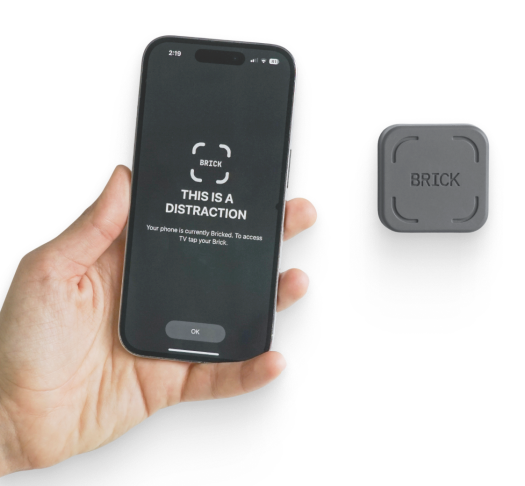
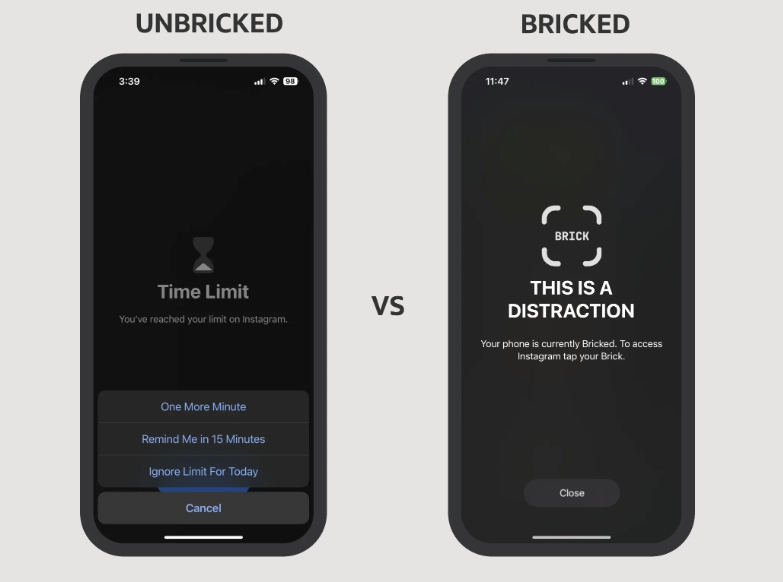
If you want to make phone free time easier to actually stick to, The Brick is worth knowing about. It is a small physical device that temporarily blocks distracting apps on your phone without complicated settings or willpower. You tap your phone to The Brick to activate it, and the only way to get those apps back is to physically return to the device. That one layer of friction is often enough to break the autopilot scroll before it starts. You can learn more and grab a discount using my link at julianneaugust.com/brick.

Take It Deeper
If you are ready to move beyond awareness and into real change, the Focus Modes Made Simple workshop will show you exactly how to use the tools already on your phone to protect your attention and create more phone free space, without willpower or complicated systems. Join the workshop here.
If you want help identifying your specific patterns around screen time, the Screen Time Personality Quiz is a free place to start. It will show you where distraction is costing you most and help you build a plan that actually fits your life.
What is attention residue and how does it affect phone free time?
Attention residue is what happens when you switch from one task to another but part of your brain stays focused on the previous task. When it comes to phone use, this means that simply putting your phone down does not immediately make you present. Your attention needs time to fully arrive in the moment you stepped into. Building consistent phone free time helps train your brain to disengage from the screen more completely, so your presence is genuine rather than just physical.
How do I deal with the restlessness I feel when I put my phone down?
Restlessness when you first go phone free is extremely common and is actually a sign your nervous system has become accustomed to constant stimulation. Rather than reaching for the phone to relieve it, stay with the discomfort for a few minutes. In most cases it settles on its own. What follows is often a quieter, more spacious feeling that makes it easier to notice the people and moments around you.
Can phone free time improve my relationship with God?
Contemplative Christian tradition has long taught that God is encountered in ordinary, present moments. Brother Lawrence described finding God in everyday tasks precisely because he was fully attentive to what was in front of him. Reducing phone distraction creates the kind of quiet attentiveness that makes you more available to hear from God in the middle of a regular day.
Leave a Review
Has the podcast helped you create healthier habits?
If you’ve learned something that’s making a real difference in your life, I’d love to hear about it! Your review not only encourages me but also helps others find this podcast and start their own journey to overcome digital distractions. I read every single one and truly appreciate your support!
WRITE A REVIEW ➞


TAKE THE QUIZ ➞
Learn to declutter your digital life, set healthy boundaries, and create spaces of rest.
Ever wonder what’s really fueling your screen habits? This quiz will help you find out! It’s quick, fun, and packed with insights to help you tackle distractions head-on. Your results will show you exactly where to start.
Take the free
Screen Time Personality Quiz!
GET THE FREE GUIDE ➞
The Simple Step to Reduce Screen Time
Imagine your phone fading into the background and notifications no longer grabbing your attention, social media feeling less tempting, and your mind finally free to focus on what truly matters. That’s the power of grayscale. It’s a simple but powerful shift.
Make Your Phone Less Addictive in Seconds
Your Guide to Grayscale will help you experience it for yourself!


DOWNLOAD ➞
Grab the encouraging
wallpapers for phone and desktop.
From uplifting Bible verses to truth-filled identity reminders, and even just-for-fun designs, these wallpapers are a great way to stay grounded throughout your day. Choose from 8 desktop and 8 phone designs.

MEET THE BRICK ➞
What if there was an actual wall between you and digital distraction? Not another screen time limit you can easily ignore, but a physical barrier that makes mindless scrolling nearly impossible. After 30 days of testing, I've found the tool that finally works: The Brick.
