Screen Time Personality Quiz
Discover Your Pathway to Digital Peace.
TAKE THE QUIZ

Guide to
Grayscale
MAKE YOUR PHONE LESS ADDICTIVE IN SECONDS.
DOWNLOAD


DOWNLOAD
Your screen can become a tool for encouragement.
Wallpapers for Desktop & Phone
Hey, I’m Julianne!
Christian Coach, encourager, digital distraction disruptor. I help people reduce their screen time, build life-giving habits, and stay focused on what matters most. The digital world isn’t going away, but your distraction can. So glad you’re here!

Welcome!

TELL ME MORE
Block Distracting Apps With One Quick Tap
Meet The Brick
September 29, 2026
88 | What Ancient Scrolls in the Bible Can Teach You About Doomscrolling
A few years ago, I stood in a small shop in Egypt and watched a craftsman make paper the ancient way. He sliced open a papyrus stalk, peeled back its tough outer skin, and cut the soft centre into thin strips. Next, he laid the strips in a crisscross pattern and pressed them flat, letting the plant’s own sap glue them into a single sheet. I didn’t realize it then, but that afternoon would change how I read about scrolls in the Bible, and how I think about the scroll I hold in my hand every day.
Scrolls show up all through Scripture, and they’re never a minor detail. They carry God’s words, His promises, and His warnings. Today, we use the same word for something very different. We scroll through news, social media, and videos, often without noticing what we’re taking in.
In this post, I’ll walk you through what scrolls in the Bible were, where they appear, and what I saw when I visited the caves where the Dead Sea Scrolls were found. After that, we’ll look at where the word “scrolling” comes from and how you can make your own scroll matter. As a certified life and habit coach and host of the Overcome Digital Distraction podcast, I help Christians move from doomscrolling to a more focused live and experience peace. This piece of history has become one of my favourite ways to do that.
What Were Scrolls in the Bible?
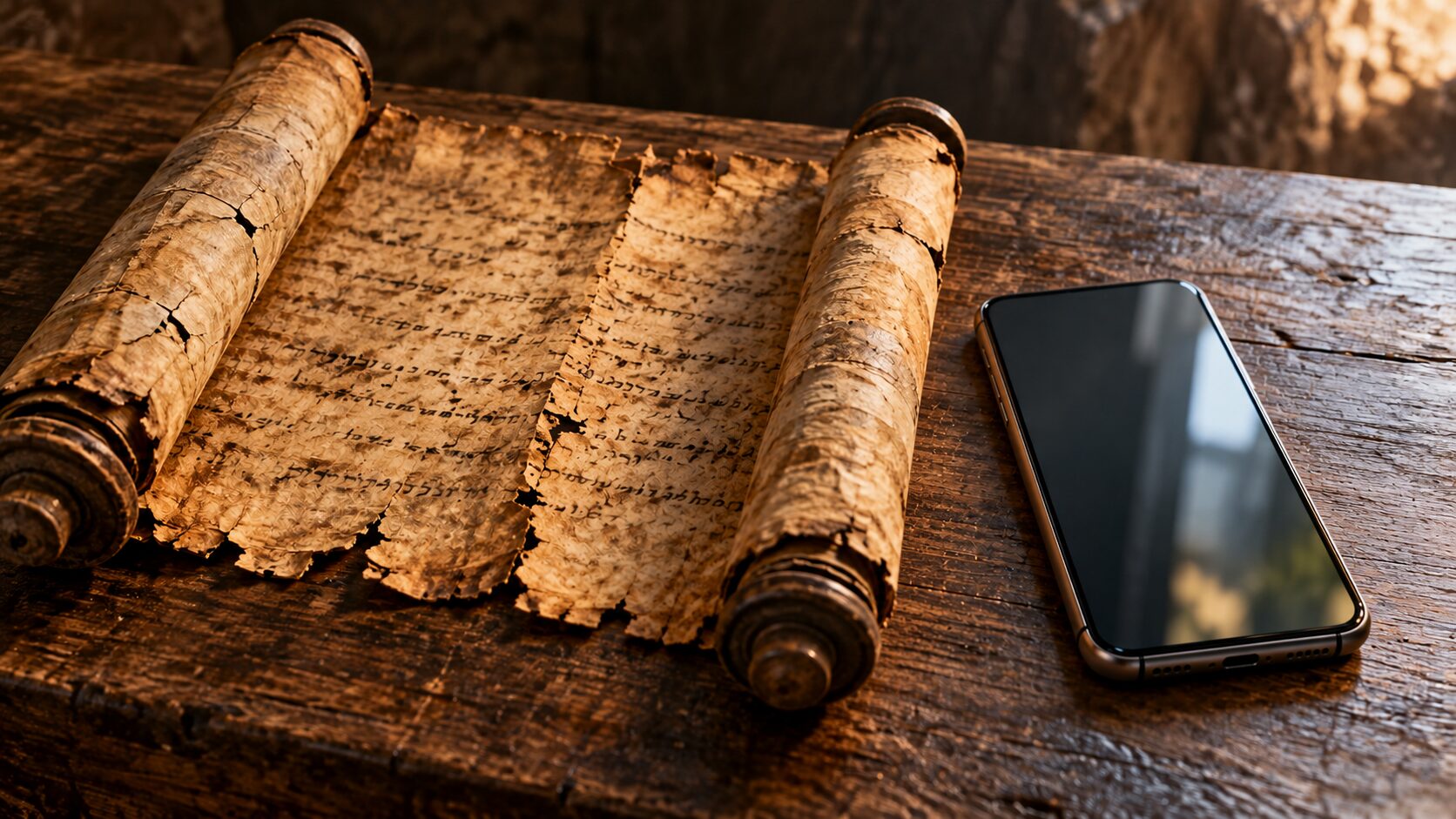
Scrolls in the Bible were long rolls of writing material used to record and preserve Scripture. Scribes joined sheets of papyrus, leather, or parchment side by side, then wound the whole strip around wooden rods with handles on each end. Readers unrolled them from right to left, since that’s the direction Hebrew is written.
Two quick definitions help here. Parchment is any animal skin prepared for writing, usually from sheep, goats, or calves. Vellum is a finer type of parchment made from calfskin, known for its smooth surface. These scrolls were also long. Many ran 20 to 30 feet, so a longer book of the Bible sometimes needed more than one scroll. For example, the Great Isaiah Scroll is made of 17 sheets of parchment stitched together and stretches more than 24 feet. JNS.org
Where Do Scrolls Appear in the Bible?
Scrolls appear in both the Old and New Testaments, often at turning points in the story. Here are five of the most memorable.
Jeremiah’s Scroll
Jeremiah 36 is one of the most dramatic scroll stories in Scripture. God told the prophet, “Take a scroll and write on it all the words I have spoken to you” (Jeremiah 36:2, NIV). However, Jeremiah couldn’t deliver the message in person. He told his scribe Baruch, “I am restricted; I cannot go to the Lord’s temple” (Jeremiah 36:5, NIV). So Jeremiah dictated every word, and Baruch wrote them down and read them aloud in his place.
Later, the scroll reached King Jehoiakim. As it was read to him, he cut off each section with a knife and threw it into the fire until the entire scroll was gone (Jeremiah 36:23). Still, God wasn’t finished. He had Jeremiah dictate the whole message again, and this time “many similar words were added to them” (Jeremiah 36:32, NIV).
The king could burn the parchment, but he couldn’t silence God. Thousands of years later, we’re still reading the words he tried to destroy.
Ezekiel’s Scroll
In Ezekiel 3, God handed the prophet a scroll and told him to eat it. Even though its words spoke of mourning and judgment, Ezekiel said “it tasted as sweet as honey in my mouth” (Ezekiel 3:3, NIV). God wanted His message inside the prophet, not just in front of him.
Zechariah’s Vision
Zechariah saw a flying scroll thirty feet long and fifteen feet wide (Zechariah 5:2). It carried a curse against stealing and swearing falsely, a picture of God’s word reaching into every home.
Isaiah Unrolled
In Luke 4, Jesus stood in the synagogue in Nazareth, unrolled the scroll of Isaiah, and read a passage about the coming Messiah. Then He rolled it up and said, “Today this scripture is fulfilled in your hearing” (Luke 4:21, NIV). The One the scroll pointed toward was standing in the room.
The Sealed Scroll
In Revelation 5, John sees a scroll sealed with seven seals. No one in heaven or on earth is worthy to open it until the Lamb steps forward and takes it.
In every one of these stories, the scroll carries something that important.
The Dead Sea Scrolls and What I Saw at Qumran
A couple of years ago, I travelled from Egypt into Israel, and one of our stops was Qumran, near the Dead Sea. The site sits on a dry, rocky plateau, and from there you can see dark cave openings in the cliffs. Israel was setting heat records that week. Standing in that desert, I remember telling someone in our group that I finally understood why the Israelites grumbled in the wilderness.
That dry air is part of why the scrolls survived. Along with steady cave temperatures and sealed clay jars, it protected animal skin and plant fibre for roughly two thousand years.
The Discovery
In 1947, a young Bedouin shepherd searching for a lost goat tossed a stone into a cave and heard pottery shatter. Inside, he found clay jars holding ancient scrolls wrapped in linen. The scrolls eventually passed to a Bethlehem cobbler who also traded in antiquities. According to the well-known account, he nearly used the leather for shoe repairs before recognizing the old writing.
That find sparked a search of the surrounding cliffs. Between 1947 and 1956, scrolls were found in eleven caves, and scholars have pieced together roughly 950 manuscripts from the fragments, according to the Israel Museum. More than 200 of them contain portions of the Bible itself, with Esther as the one well-known book missing. Many historians believe a Jewish group called the Essenes hid the scrolls around AD 68, as a Roman army closed in.
The Museum
The Great Isaiah Scroll was one of the first seven scrolls found in that original cave. Today, it belongs to the Israel Museum’s Shrine of the Book in Jerusalem. Because parchment is so sensitive to light and changes in climate, the original is normally kept under tightly controlled conditions, while a facsimile sits in the central dome. That reproduction is what I saw, and it still took my breath away. JNS.org
The building surprised me too. Its white dome is shaped like the lids of the clay jars that held the scrolls, and much of the museum sits underground, echoing the cool, dark caves where they stayed hidden for centuries. A whole building was designed to keep God’s words safe.
Where the Word “Scrolling” Comes From
Standing in that museum, something clicked for me. The word we use for our phones has deep roots.
In their 2022 book Scribes and Scripture, John Meade and Peter Gurry explain that our modern words “tablet” and “scrolling” both trace back to ancient writing tools. Tablets were the wax and clay surfaces people wrote on long before paper was common. Scrolling, on the other hand, describes the physical motion of reading a scroll, pulling material from one side while it wound up on the other.
When you swipe through your phone, you’re doing a version of that same motion. You simply use a thumb instead of two hands and a roll of parchment.
How Ancient Scrolls and Modern Scrolling Differ
Although the word is the same, the experience couldn’t be more different.
An ancient scroll made you read in order, one column after another. You couldn’t jump around without rewinding it by hand. Most importantly, it had an ending. Eventually, the reader reached the last column and stopped, which left room to think about what they’d just read.
Modern scrolling has no built-in endpoint. Instead, an algorithm often decides what appears next, and the feed keeps refreshing long after we’ve stopped paying attention. As a result, one thing blurs into the next, and very little sinks in.
Ancient people held the scroll. If we’re not careful, today’s scroll can start holding us.
That raises a bigger question than what we’re looking at. The deeper question is whose voice we’re allowing to shape us. We even talk about “consuming content” today, and Ezekiel was told to consume the words God gave him. In other words, you’re always consuming something. What matters is what you’re feeding your mind and spirit.
How to Make Your Scroll Matter
Your phone isn’t the enemy. Some of what you find there is good, and some of it even reflects God’s truth. What you need is a filter and a finish line. These three steps will help you build both and help you overcome digital distraction.
Decide First
Set your stopping point before you start scrolling, not after twenty minutes have already disappeared. Here are four simple ways to decide ahead of time.
- Set a timer for a specific number of minutes before you unlock your phone.
- Pick a number, like five posts or three videos, and count as you go.
- Tie it to something physical, such as stopping when your coffee cup is empty.
- Say it out loud before you begin, even if no one else is in the room.
Filter Wisely
Before you give something room in your heart and mind, ask yourself three questions.
- Is this shaping me to look more like Christ?
- Is this something I’d want to remember and hide in my heart?
- Whose voice is getting the most room in me right now?
If the answer is no, it’s noise, no matter how loud it felt for a moment. Our feeds can feel urgent while being temporary. Meanwhile, God’s Word may seem softer by comparison, yet “the word of our God endures forever” (Isaiah 40:8, NIV).
Stop and Reflect
Somewhere in your scrolling, one thing will stand out. It might be a thought that’s good for your life, a truth that could help your family, or a moment that builds your faith. When you find it, stop. Don’t keep swiping in search of the next thing. Instead, stay with it for a few minutes. Think about what it means for your life and how you might live differently because of it.
The psalmist wrote, “I have hidden your word in my heart that I might not sin against you” (Psalm 119:11, NIV). That kind of hiding takes time, and it starts when you stop long enough to let something sink in.
Your Next Step
Scrolls in the Bible carried words meant to last. Kings tried to burn them, shepherds stumbled onto them, and an entire museum was built to protect them. Your scroll works differently, since it never runs out unless you decide where it ends. Choose your stopping point in advance, filter what gets access to your heart, and pause when something good finds you.
If you’d like a daily reminder to scroll with purpose, download my free phone wallpapers. They put a simple visual cue right on your lock screen, so you see it before you start scrolling.
For more encouragement like this, listen to the Overcome Digital Distraction podcast. Each week, I share practical, faith-filled ways to build healthier digital habits.
If you’ve ever looked up from your phone and wondered where the last hour went, you might be ready to set up your phone around what matters most. My Focus Modes Made Simple workshop walks you step by step through setting up your phone so it supports your priorities instead of pulling you away from them. Enrol today and start using your phone on purpose.
Frequently Asked Questions
What is the meaning of scrolls in the Bible?
Scrolls in the Bible were long rolls of papyrus, leather, or parchment used to write and preserve God’s words. They often appear at key moments in Scripture, such as Jeremiah 36, Ezekiel 3, Luke 4, and Revelation 5, where they carry messages of warning, promise, or fulfilment.
Why did Ezekiel eat a scroll?
God told Ezekiel to eat a scroll as a picture of taking His words fully inside himself before speaking them to others. Even though the message was about mourning and judgment, Ezekiel said it tasted as sweet as honey (Ezekiel 3:3).
What does the Bible say about doomscrolling?
The Bible doesn’t mention doomscrolling by name, but it speaks often about what we let into our hearts. Verses like Psalm 119:11 and Philippians 4:8 encourage believers to fill their minds with what is true and lasting, which offers a helpful filter for a Christian approach to doomscrolling.
Leave a Review
Has the podcast helped you create healthier habits?
If you’ve learned something that’s making a real difference in your life, I’d love to hear about it! Your review not only encourages me but also helps others find this podcast and start their own journey to overcome digital distractions. I read every single one and truly appreciate your support!
WRITE A REVIEW ➞


TAKE THE QUIZ ➞
Learn to declutter your digital life, set healthy boundaries, and create spaces of rest.
Ever wonder what’s really fueling your screen habits? This quiz will help you find out! It’s quick, fun, and packed with insights to help you tackle distractions head-on. Your results will show you exactly where to start.
Take the free
Screen Time Personality Quiz!
GET THE FREE GUIDE ➞
The Simple Step to Reduce Screen Time
Imagine your phone fading into the background and notifications no longer grabbing your attention, social media feeling less tempting, and your mind finally free to focus on what truly matters. That’s the power of grayscale. It’s a simple but powerful shift.
Make Your Phone Less Addictive in Seconds
Your Guide to Grayscale will help you experience it for yourself!


DOWNLOAD ➞
Grab the encouraging
wallpapers for phone and desktop.
From uplifting Bible verses to truth-filled identity reminders, and even just-for-fun designs, these wallpapers are a great way to stay grounded throughout your day. Choose from 8 desktop and 8 phone designs.

MEET THE BRICK ➞
What if there was an actual wall between you and digital distraction? Not another screen time limit you can easily ignore, but a physical barrier that makes mindless scrolling nearly impossible. After 30 days of testing, I've found the tool that finally works: The Brick.
