Screen Time Personality Quiz
Discover Your Pathway to Digital Peace.
TAKE THE QUIZ

Guide to
Grayscale
MAKE YOUR PHONE LESS ADDICTIVE IN SECONDS.
DOWNLOAD


DOWNLOAD
Your screen can become a tool for encouragement.
Wallpapers for Desktop & Phone
Hey, I’m Julianne!
Christian Coach, encourager, digital distraction disruptor. I help people reduce their screen time, build life-giving habits, and stay focused on what matters most. The digital world isn’t going away, but your distraction can. So glad you’re here!

Welcome!


TELL ME MORE
Block Distracting Apps With One Quick Tap
Meet The Brick
March 17, 2026
60 | Stop Your Mindless Scrolling Habit With One Simple Fix
There is a moment that happens dozens of times every day. Your hand reaches for your phone. Before a thought has formed, it unlocks, an app fills your screen, and your brain never had the chance to ask whether you meant to be there. That gap between the impulse and mindless scrolling has been quietly engineered out of your life.
The mindless scrolling habit is not a willpower problem. It is a design problem, and the fix is already sitting inside your phone. In this post, you will learn why the pause matters, what research says it does to your brain, and two practical ways to build one in today.
Your Phone Has No Speed Bumps
Imagine living next door to a bakery. The door is always propped open, a fresh sample sits at eye level on the sidewalk every morning, and the smell reaches you before you have made any decision at all. Most people would wander in without meaning to, because the environment pulls them in before a choice is ever required.
That is exactly what your phone is doing. Your apps, particularly social media, are those samples on the sidewalk. Your home screen is that propped-open door.
The 89% Problem
Research from the London School of Economics found that only 11% of smartphone checks happen because of a notification. The other 89% of the time, people picked up their phones with no alert, no buzz, nothing calling them over. (Heitmayer & Lahlou, 2021) They simply arrived. For most of the time you spend on your phone, you never consciously chose to be there.
Why It Keeps Happening
Face ID and fingerprint unlock work in a fraction of a second. Your most-used apps sit front and centre on the home screen, waiting. So when a quiet moment appears, a checkout line, a boiling kettle, a pause between tasks, your hand reaches before your brain registers what is happening. The phone is open. The app is right there. You are already scrolling before any part of you had a chance to decide whether this is how you wanted to spend the next twenty minutes.
There is nothing standing between that nudge and the scroll. Breaking the mindless scrolling habit, then, is not really about motivation. It is about rebuilding the missing space — a small and intentional speed bump right at the front door of your phone.
What a Pause Actually Does to Your Brain
Viktor Frankl, the Austrian psychiatrist and Holocaust survivor, is often credited with this idea, though researchers have also traced it through Stephen Covey, who built much of his well-known 7 Habits of Highly Effective People around it:
“Between stimulus and response there is a space. In that space is our power to choose our response. In our response lies our growth and our freedom.”
Between the thing that triggers you and the thing you do about it, there is a gap. In that gap lives your freedom to choose. Modern smartphones collapse that gap to zero, because the less time you spend deciding, the more time you spend consuming. The pause has been quietly removed.
What the Research Shows
A developer named Frederik Riedel built an app called One Sec after growing frustrated with his own mindless Instagram habit. The concept is simple. Every time you try to open a designated app, it makes you wait about ten seconds. You see a breathing animation. You take one breath. Then you are asked whether you actually want to open this.
No hard block. No alarm. Just a breath and a question.
Researchers at Heidelberg University and the Max Planck Institute for Human Development studied 280 people over six weeks. App usage dropped by 57% on average. Even more striking, 36% of the time when that pause appeared, people chose not to open the app at all. (Grüning, Riedel & Lorenz-Spreen, PNAS, 2023) They had been reaching on complete autopilot, and the moment they were given a breath to think, they realised they didn’t even want to be there.
The pause didn’t block anything. It simply returned the space to choose.
Faith and the Pause
For those of us who follow Jesus, there is a deeper layer here. One conscious breath shifts your body out of a reactive, scattered state and into something calmer and more grounded. That stillness is exactly where the Holy Spirit has room to speak. Reclaiming the power of a pause is not just a habit strategy. It is a spiritual practice.
Two Ways to Build Your Own Pause
You don’t need to overhaul your phone or spend any money to get started. These two options are practical and accessible, and you can act on either one today. Pick one and try it this week.
Option One
Turn Off Biometric Unlock
This change works better than most people expect, and every phone already has it as an option.
Face ID and fingerprint unlock are genuinely impressive. As someone whose love language is efficiency, I appreciate the convenience deeply. But when the mindless scrolling habit is what you are trying to break, that convenience becomes the liability. The door opens before your brain knows you are reaching for the handle. There is zero space between the impulse and the app.
Switching from biometrics to a passcode puts a lock back on that door. Now every time you pick up your phone, your hands have to do something intentional before anything opens. Those few seconds of typing become your pause. Your brain catches up with your thumb, and you get to ask whether this is actually where you meant to go.
How to Make the Switch
- iPhone: Settings → Face ID and Passcode → toggle off iPhone Unlock
- Android: Settings → Security or Biometrics → turn off fingerprint or face unlock for the lock screen
Your face stays registered and nothing gets deleted. You are simply telling your phone to stop using it for automatic unlocking. It will feel counterintuitive at first, because your phone was built for speed and a passcode feels like a step backward. That is precisely why it works. If autopilot phone use is genuinely costing you, a little friction is not the enemy. It is the solution. Give it a week and notice what shifts.
Option Two
Try the One Sec App
If you want something more targeted, One Sec adds a pause specifically before whichever apps pull you in most, whether that is Instagram, TikTok, YouTube, Facebook, or something else entirely. It is free on both iPhone and Android.
Every time you try to open a selected app, One Sec steps in before it loads. You get a short breathing animation, take one breath, and then choose to continue or close. Nothing gets taken away. You can still access every app. You are simply given back the moment to decide whether you actually want to.
Over time, your brain stops associating that app with instant, frictionless reward, because now there is always a breath in between. The grip of the mindless scrolling habit starts to loosen.
Getting Started
The free version covers one app, and starting there is exactly right. Pick the one that pulls you in most and costs you the most time without your permission, and let One Sec be the pause before you walk through that door. A paid version unlocks multiple apps and includes a free trial week, so if the free version is already making a difference, it is worth considering. Get 1 month free with my link below.
One Sec App
Get one free month: https://one-sec.app (You can use one sec pro on all your personal devices (iPhone, iPad, Android, Computer).
Go Further with Focus Modes Made Simple
Your phone already has a built-in feature on both iPhone and Android called Focus Modes. When you set them up with intention, they become one of the most powerful tools available for breaking the mindless scrolling habit before it even starts.
In my workshop Focus Modes Made Simple, I walk you through how to build custom Focus Modes step by step, with no tech overwhelm. I have also created a gallery of 40 custom wallpapers designed for specific moments in your day, so your lock screen becomes a pause that catches you right at the door. Imagine picking up your phone in the morning and seeing the words: Seek first, scroll later. That message is its own invitation to choose.
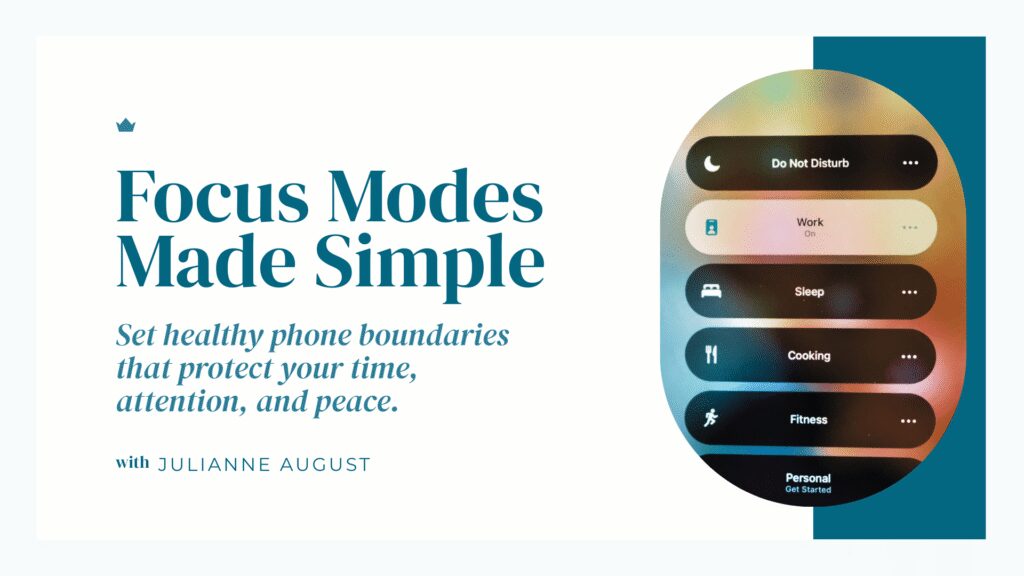
You will go from constantly checking your phone to confidently building Focus Modes that protect your time, guard your attention, and support the rhythms that matter most to you.
Inside the workshop you will receive:
- A personal planning workbook
- A gallery of 40 digital phone wallpapers for your lock screen
- Step-by-Step written iphone & Android instructions
Check out Focus Modes Made Simple to find out more, and take your natural next step.
The Deeper Truth About Choosing
Beyond the apps and settings, there is something worth sitting with.
God created you with free will, the genuine and beautiful capacity to choose. Scripture is full of this invitation. In Deuteronomy 30, Moses stands before the people and tells them that life and death, blessing and cursing, have been set before them. The choosing is entirely theirs. That thread runs all the way through the Bible, because God does not want people who simply react on autopilot. He wants people who turn toward Him, who reach for Him, who choose well.
When your phone eliminates the pause, something important gets quietly eroded. Not just your time, but your agency — the very quality that makes your choices actually yours. Reclaiming the pause means choosing to be someone who decides rather than someone who drifts. That kind of intentionality, practised in small moments throughout the day, is how lasting change actually begins.
Start With One Pause Today
Breaking the mindless scrolling habit does not require a dramatic overhaul. It requires one small thing: a speed bump right at the front door of your device.
This week, choose one option. Turn off Face ID and let your passcode be your pause, or download One Sec for free, pick your most distracting app, and let ten seconds do the work. Either way, you are not giving anything up. You are simply reclaiming the space to choose.
If you are ready to go further, Focus Modes Made Simple will walk you through building a phone environment that interrupts the mindless scrolling habit from the moment you pick up your device. It is already inside your phone, waiting to be set up.
Frequently Asked Questions
Why do I keep picking up my phone without meaning to?
Your phone removes every moment of friction between you and your apps. Face ID unlocks it instantly, your most-used apps are right there on the home screen, and years of repetition have trained your hand to reach automatically in any quiet moment. This is not a character flaw. It is the predictable result of intentional design.
Does turning off Face ID actually help?
It does, and often more than people expect. Switching to a passcode adds just a few seconds of friction every time you unlock your phone. That small delay gives your brain a chance to register what you are doing before you are already inside an app.
What is the One Sec app and how does it work?
One Sec intercepts you before a selected app opens and plays a short ten-second breathing animation. After one breath, you choose to continue or close. A peer-reviewed study published in PNAS found it reduced app usage by 57% over six weeks, and 36% of the time, users chose not to open the app at all.
What does the power of a pause have to do with faith?
Viktor Frankl described the space between stimulus and response as the place where our freedom to choose lives. Scripture affirms this from beginning to end. God created us to choose, not to react on autopilot. When our phones eliminate that space, our agency quietly erodes. Reclaiming the pause is an act of stewardship over your attention and your time.
Leave a Review
Has the podcast helped you create healthier habits?
If you’ve learned something that’s making a real difference in your life, I’d love to hear about it! Your review not only encourages me but also helps others find this podcast and start their own journey to overcome digital distractions. I read every single one and truly appreciate your support!
WRITE A REVIEW ➞


TAKE THE QUIZ ➞
Learn to declutter your digital life, set healthy boundaries, and create spaces of rest.
Ever wonder what’s really fueling your screen habits? This quiz will help you find out! It’s quick, fun, and packed with insights to help you tackle distractions head-on. Your results will show you exactly where to start.
Take the free
Screen Time Personality Quiz!
GET THE FREE GUIDE ➞
The Simple Step to Reduce Screen Time
Imagine your phone fading into the background and notifications no longer grabbing your attention, social media feeling less tempting, and your mind finally free to focus on what truly matters. That’s the power of grayscale. It’s a simple but powerful shift.
Make Your Phone Less Addictive in Seconds
Your Guide to Grayscale will help you experience it for yourself!


DOWNLOAD ➞
Grab the encouraging
wallpapers for phone and desktop.
From uplifting Bible verses to truth-filled identity reminders, and even just-for-fun designs, these wallpapers are a great way to stay grounded throughout your day. Choose from 8 desktop and 8 phone designs.

MEET THE BRICK ➞
What if there was an actual wall between you and digital distraction? Not another screen time limit you can easily ignore, but a physical barrier that makes mindless scrolling nearly impossible. After 30 days of testing, I've found the tool that finally works: The Brick.
