Screen Time Personality Quiz
Discover Your Pathway to Digital Peace.
TAKE THE QUIZ

Guide to
Grayscale
MAKE YOUR PHONE LESS ADDICTIVE IN SECONDS.
DOWNLOAD


DOWNLOAD
Your screen can become a tool for encouragement.
Wallpapers for Desktop & Phone
Hey, I’m Julianne!
Christian Coach, encourager, digital distraction disruptor. I help people reduce their screen time, build life-giving habits, and stay focused on what matters most. The digital world isn’t going away, but your distraction can. So glad you’re here!

Welcome!


TELL ME MORE
Block Distracting Apps With One Quick Tap
Meet The Brick
January 13, 2026
51 | How to Break Bad Habits That Keep You Scrolling
Biblical Truth Meets Brain Science
You know exactly when and why you reach for your phone. You’ve seen the screen time reports. You’ve tracked your patterns and identified your triggers. You’ve brought those automatic habits into the light.
But here’s the hard truth: awareness alone doesn’t change anything.
You can know exactly what you’re doing wrong and still keep doing it. That’s the gap most of us get stuck in, the space between seeing clearly and actually doing something about it. If you want to know how to break bad habits, you need more than awareness. You need a strategy that addresses both your heart and your brain.
This is where biblical wisdom and modern neuroscience beautifully intersect, offering you a roadmap for real, lasting transformation.
The Biblical Foundation for Habit Change
Before diving into strategies and techniques, we need to start where transformation actually begins. Romans 12:2 gives us the blueprint:
“Do not conform to the pattern of this world but be transformed by the renewing of your mind. Then you will be able to test and approve what God’s will is, His good, pleasing, and perfect will.”
Notice what Paul doesn’t say. He doesn’t tell us to start with our behavior or rely on behavior modification alone. He points us directly to the mind.
Renewing Your Mind With Scripture Isn’t Just Positive Thinking
Renewing your mind with scripture isn’t about positive thinking or simply changing the way you interpret the world. It comes from anchoring your mind in truth, allowing God’s Word to reshape the way you think, desire, and discern.
When you learn to think with Christ and align your thoughts with Scripture, you let God’s truth challenge old patterns. The Holy Spirit forms new ways of responding from the inside out. As your mind is renewed in Christ, your perspective begins to shift, not because you’re forcing change, but because truth is slowly reordering what you believe, what you value, and how you live.
As God renews your mind, your desires begin to change. Your patterns begin to change. Eventually, your habits follow.
How Your Brain Actually Works
Here’s incredible news: God created your brain with the capacity to change. That means your habits can change and your attention can be reclaimed. This isn’t just a scientific discovery, it’s a reflection of God’s design.
Scripture has always pointed us toward renewal, and science is now explaining how that renewal takes place in the brain. Neuroplasticity simply means your brain is constantly forming and strengthening new pathways based on what you practice and repeat.
Why Habit Change Feels So Impossibly Hard
Let me tell you something about your brain that might surprise you. It’s also designed to resist change. Neuroscientists call it homeostasis, your brain’s preference for the familiar, even when the familiar isn’t good for you.
When you try to change a habit, your brain actually fights back because the old pattern feels safe, predictable, efficient. That’s not a character flaw, it’s biology.
The patterns you’ve been stuck in are strong because you’ve practiced them thousands of times. It’s like a rut worn deep into a trail. Your brain automatically follows that path because it’s the easiest route.
But they’re not permanent.
How Neurons Wire Together to Create Automatic Patterns
Every time you repeat a behavior, you strengthen the neural pathway connected to that behavior. You may have heard the phrase “neurons that fire together wire together.”
The more you practice reaching for your phone when you’re bored, the stronger that connection becomes. But the opposite is also true.
When you practice a new response or routine, when you choose to take three deep breaths instead of scrolling, when you pick up a book instead of your phone, you’re creating a new neural pathway. At first it’s faint, like stepping through tall grass. But the more you practice it, the more worn that new path becomes.
Eventually, with enough repetition, that new pathway can become just as automatic as the old one. You can build new pathways. You can interrupt the old habit loops and create new ones.
The Gap Between Knowing and Doing
Here’s the gap most of us get stuck in: the space between knowing something and doing something. You can understand exactly what’s happening. You know when you reach for your phone. You know why. You even know it’s not helping.
But you still do it.
Why? Because awareness alone doesn’t change behavior.
Why Understanding the Mechanics of Habits Gives You Power
You need to understand the mechanics of how habits actually work. When you understand the habit loop, you stop being controlled by it. You can learn to interrupt it.
This is the difference between someone who knows they should reduce your screen time and someone who actually does it. Knowledge without a strategy leaves you stuck. Understanding the system gives you power to change it.
If you’re feeling overwhelmed by where to start, take the Screen Time Personality Quiz to discover your unique digital distraction patterns and get a personalized action plan.
How to Break Bad Habits Using the Habit Loop
To break a cycle, you first have to understand how it works. Every habit follows a loop: cue, routine, reward.
The Cue
The cue is the trigger, the moment that sets everything in motion. For you, it might be boredom, stress, sitting down at your desk or in a certain chair, or picking up your phone to check the time.
The Routine
The routine is what you do in response to that cue. You open Instagram. You scroll the news. You check your email for the third time in ten minutes.
The Reward
The reward is what your brain gets from that routine. Relief, distraction, a hit of dopamine, a sense of connection, even if it’s shallow.
Your brain has learned this loop so well that it runs automatically now. The cue happens, the routine fires, and the reward is delivered. Over and over, thousands of times. That’s why it feels so hard to know how to stop scrolling. Your brain is doing exactly what it’s been trained to do.
But you can rewire it.
Practical Steps to Interrupt the Loop
The strategy for breaking bad habits is simple but powerful: interrupt the loop. Create friction between the cue and the routine. Create space between your impulse and action.
Because once you disrupt the automatic pattern, you open up room for a different choice.
Change Your Environment First to Create Friction
Your environment shapes your habits far more than willpower ever will. If your phone is always within arm’s reach, your hand will reach for it. It’s automatic.
Start by noticing where your phone lives throughout the day. Is it sitting next to you on the couch? On your nightstand? In your pocket? Write down the pattern you observe.
Then make one small change. Put it in another room during dinner. Leave it in your car when you get home. Charge it in the kitchen instead of your bedroom.
These tiny shifts create friction. And friction creates choice.
Identify What Your Heart Is Really Seeking
Your phone isn’t the problem. It’s the solution your brain reaches for when you need something. Relief from boredom. Escape from stress. A sense of connection.
Ask yourself: what am I really looking for when I scroll?
Sit with that question for a minute. Maybe you realize you’re looking for comfort. Or validation. Or just something to fill the empty space.
Name it. Then ask God to meet that need.
This is digital wellness at its deepest level, addressing not just the behavior but the heart behind it.
Replace the Routine But Keep the Reward
You don’t have to eliminate the reward your brain is seeking. You just need to find a better way to get it.
If you’re seeking relief from stress, try three deep breaths instead of scrolling. If you’re looking for connection, send a text to a friend instead of opening social media. If you need a mental break, step outside for two minutes instead of checking the news.
Same reward. Different routine. Healthier habit loop.
Building New Pathways Through Repetition
Real habit change doesn’t happen through massive overhauls. It happens through small, consistent actions repeated over time.
Think of it like this: you didn’t develop your current phone habits overnight. They were built one scroll at a time, one notification at a time, one automatic reach at a time. Breaking them works the same way.
One intentional pause at a time. One new response at a time. One small victory at a time.
Partner With the Holy Spirit in the Process
Here’s where faith and neuroscience work together beautifully. As you practice new habits, you’re literally rewiring your brain. But you’re not doing this alone.
The Holy Spirit is your partner in this process. He gives you the strength when your willpower runs out. He convicts you when you slip back into old patterns. He renews your mind with truth when lies tell you change is impossible.
This is transformation from the inside out.
Your Next Step Forward
Knowing how to break bad habits isn’t enough. You have to take action.
If you’re ready to move from awareness to transformation, download the Digital Habit Reset Guide at julianneaugust.com/reset. This 30-day guide walks you through not just seeing your patterns, but understanding them deeply enough to actually rewire them. The guide pairs with a 4-week podcast series on the Overcome Digital Distraction Podcast, get the guide and follow along.
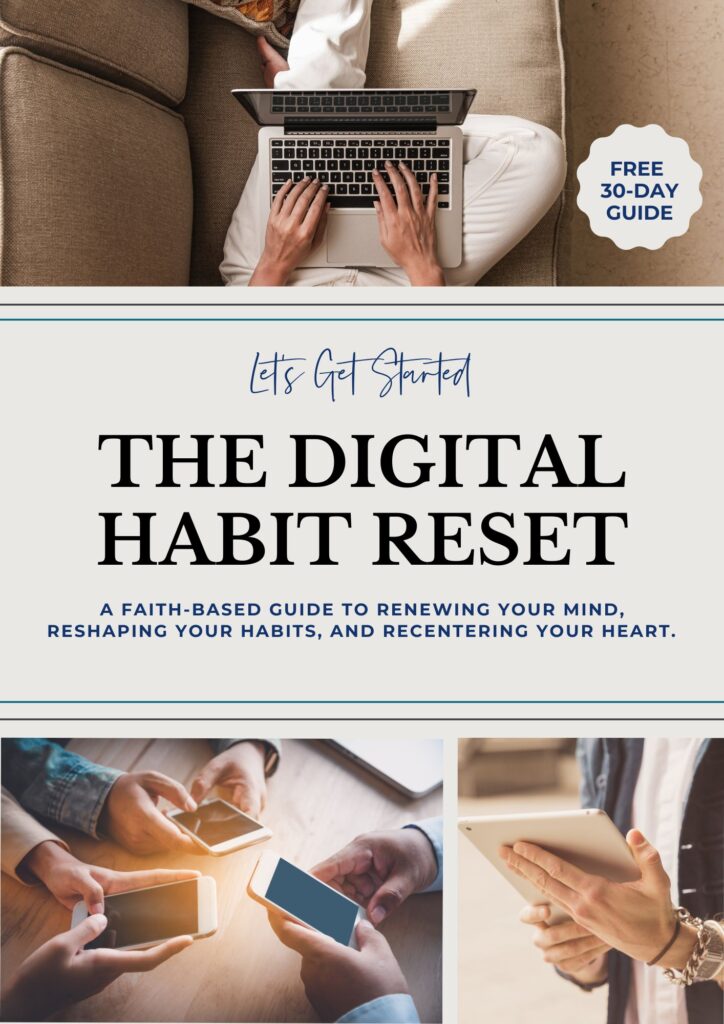
Each day includes a reflection that combines biblical truth with brain science, a question to help you create awareness, and one small, doable practice that reshapes your habits. Week 2 focuses specifically on breaking the cycle and interrupting your automatic loops.
When you sign up, you’ll also receive custom wallpapers designed for both your phone and desktop. These aren’t just pretty backgrounds. They’re visual reminders that help anchor your intention throughout the day, featuring Scripture verses and truth-filled reminders about what matters most.
Ready for a personalized starting point? Take the Screen Time Personality Quiz and get your 3-Day Digital Peace Plan, a free guide to help you reset your screen habits and reclaim your focus. This personalized assessment will show you exactly where to start based on your unique digital distraction patterns.
Would you share it with a friend? Send them to julianneaugust.com/reset so they can participate too. Sometimes the best way to stay committed is to bring someone along with you.
Frequently Asked Questions
How long does it take to break a bad habit?
Research suggests it takes anywhere from 18 to 254 days to form a new habit, with an average of 66 days. But here’s the truth: it’s not about hitting a magic number. It’s about consistent practice. Some habits change quickly. Others take longer. Focus on progress, not perfection.
What if I keep failing at habit change?
Failure isn’t the opposite of success. It’s part of the process. Every time you notice yourself slipping back into an old pattern, you’re building awareness. Every time you choose differently, even once, you’re strengthening a new pathway. Don’t let shame keep you stuck. Let grace keep you moving forward.
Can I really change my brain?
Absolutely. Neuroplasticity is real, and it’s happening in your brain right now. The question isn’t whether your brain can change. The question is: what are you training it to do? Every choice you make is either strengthening an old pathway or building a new one.
Do I have to give up my phone completely?
No. This isn’t about eliminating technology. It’s about stewarding it well. The goal is intentionality, not isolation. You can use your phone in ways that serve your life instead of stealing from it. It’s about knowing how to break bad habits without swinging to the opposite extreme.
What’s the first step I should take today?
Start with awareness. Notice your patterns. Track when and why you reach for your phone. Identify your triggers. Then pick one small change to make in your environment. Move your phone to a different location during one specific part of your day. That’s it. One small step.
The Truth About Transformation
Change doesn’t happen in just one way. There’s the spiritual work God is doing in your heart, and there are the practical steps you take each day with your habits.
When those two come together, when heart and habits align, real transformation begins.
You serve a God who specializes in using small, faithful actions to create significant spiritual transformation. Think about David gathering five smooth stones before facing Goliath. Consider the widow offering her two small coins at the temple. Remember the boy with just five loaves and two fish.
In God’s economy, small acts of faithful stewardship matter deeply.
So here’s the question: How are you stewarding your digital life?
You don’t need to overhaul everything all at once. Pick one area. Make one change. Interrupt one loop. Partner with the Holy Spirit. Trust the process.
Little by little, choice by choice, habit by habit, you can take back your attention and direct your heart toward what truly matters.
Leave a Review
Has the podcast helped you create healthier habits?
If you’ve learned something that’s making a real difference in your life, I’d love to hear about it! Your review not only encourages me but also helps others find this podcast and start their own journey to overcome digital distractions. I read every single one and truly appreciate your support!
WRITE A REVIEW ➞


TAKE THE QUIZ ➞
Learn to declutter your digital life, set healthy boundaries, and create spaces of rest.
Ever wonder what’s really fueling your screen habits? This quiz will help you find out! It’s quick, fun, and packed with insights to help you tackle distractions head-on. Your results will show you exactly where to start.
Take the free
Screen Time Personality Quiz!
GET THE FREE GUIDE ➞
The Simple Step to Reduce Screen Time
Imagine your phone fading into the background and notifications no longer grabbing your attention, social media feeling less tempting, and your mind finally free to focus on what truly matters. That’s the power of grayscale. It’s a simple but powerful shift.
Make Your Phone Less Addictive in Seconds
Your Guide to Grayscale will help you experience it for yourself!


DOWNLOAD ➞
Grab the encouraging
wallpapers for phone and desktop.
From uplifting Bible verses to truth-filled identity reminders, and even just-for-fun designs, these wallpapers are a great way to stay grounded throughout your day. Choose from 8 desktop and 8 phone designs.

MEET THE BRICK ➞
What if there was an actual wall between you and digital distraction? Not another screen time limit you can easily ignore, but a physical barrier that makes mindless scrolling nearly impossible. After 30 days of testing, I've found the tool that finally works: The Brick.
