Screen Time Personality Quiz
Discover Your Pathway to Digital Peace.
TAKE THE QUIZ

Guide to
Grayscale
MAKE YOUR PHONE LESS ADDICTIVE IN SECONDS.
DOWNLOAD


DOWNLOAD
Your screen can become a tool for encouragement.
Wallpapers for Desktop & Phone
Hey, I’m Julianne!
Christian Coach, encourager, digital distraction disruptor. I help people reduce their screen time, build life-giving habits, and stay focused on what matters most. The digital world isn’t going away, but your distraction can. So glad you’re here!

Welcome!

TELL ME MORE
Block Distracting Apps With One Quick Tap
Meet The Brick
June 23, 2026
74 | What Is a Dopamine Menu and How to Build One So Your Brain Can Break Unhealthy Phone Habits
Every time you reach for your phone, your brain is chasing something. You probably already know that. But what if, instead of fighting that pull with willpower alone, you gave your brain something better to reach for?
That is exactly what a dopamine menu does. And by the end of this post, you are going to want to build one.
What Is Dopamine, Really?
Before we get into the menu itself, it helps to understand what dopamine actually is, because it is not what most people think.
Dopamine is a chemical your brain produces that is connected to anticipation, motivation, and reward. It is not a villain. It is actually a gift. Your brain releases dopamine when you move toward something pleasurable or meaningful, whether that is a good meal, a creative project you love, a meaningful conversation, or the quiet satisfaction of finishing something hard.
Dopamine is what gets you off the couch and into life.
The problem is not dopamine. The problem is where we have been training our brains to get it.
How Your Phone Hijacks the System
Here is what most people do not realize: your phone is a dopamine delivery machine, and it was engineered to be one.
Every text that comes in is a potential dopamine trigger. Your brain wants to know whether it will be something exciting, something important, something that needs your attention. Every notification badge, every social media refresh, every news alert, every shopping ping is working on the same neurological system.
It works exactly the way a slot machine does. You do not get hooked on a slot machine because it pays out every time. You get hooked because it might. The unpredictability is the hook. And your phone is full of it.
The people who design these apps understand dopamine better than most of us do, and they have built entire products around triggering it as often as possible. So if you have ever felt like the pull toward your phone is stronger than your desire to put it down, that is not a character flaw. That is your brain responding to a system specifically engineered to exploit its natural wiring.
The hits your phone delivers are fast and cheap. They do not satisfy deeply. They just keep you coming back for more.
If you want to go deeper on this cycle, my post on dopamine detox walks through what it looks like to intentionally reset that pattern.
What Is a Dopamine Menu?
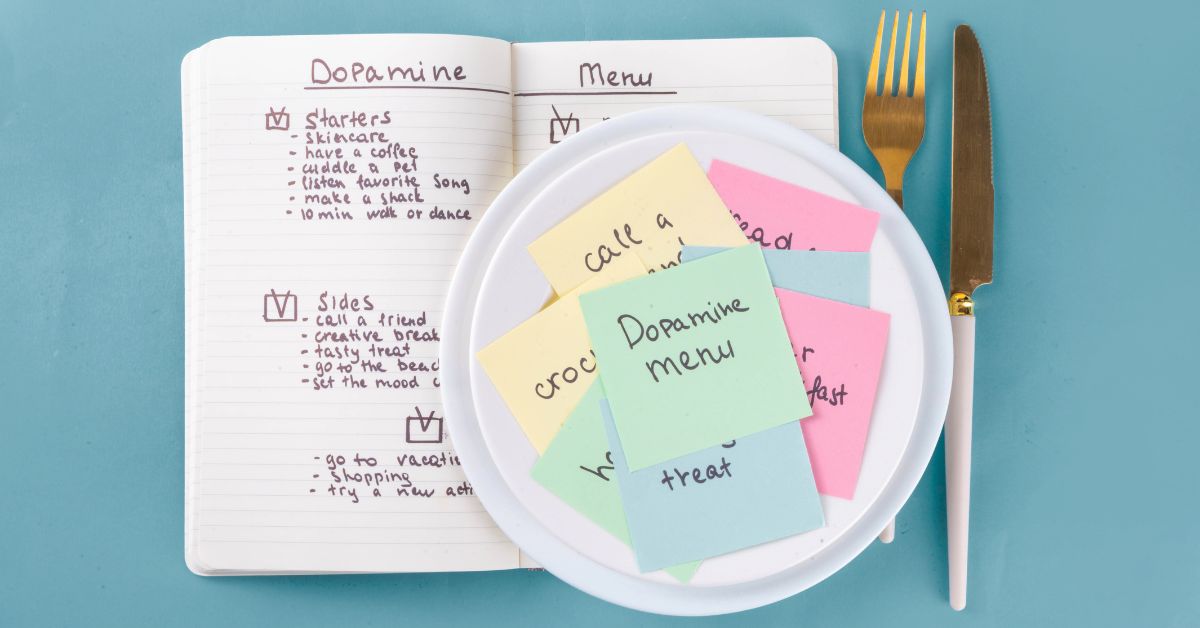
A dopamine menu is a pre-planned list of activities that give your brain a genuine dopamine reward, organized by how much time you have and what you feel like doing in the moment.
The idea is beautifully simple. Your brain still needs dopamine. That is not going to change, and you would not want it to. So instead of defaulting to your phone when that pull arrives, you have a personalized menu of real alternatives already waiting. Just like a restaurant menu, it is organized into categories so you can find something that fits the moment.
I first heard this concept from someone I mentor named Rebecca, and I have to give her full credit. She showed up to our conversation having already built one. It was one of the most practical, creative ideas I have heard in this space.
Her menu had four categories: sides, appetizers, mains, and desserts.
Sides
Sides are things you can do in the background while already doing something else. Put on worship music. Start an audiobook or a podcast. Light a candle. Open a window. These are small sensory shifts that change the feel of what you are already doing without requiring you to stop.
Appetizers
Appetizers take five to fifteen minutes. Make yourself something special to drink, a fancy tea, a greens drink, something that genuinely feels like a treat. Step outside for some sunshine. Put your feet on the ground. Read one article you have been meaning to get to. Write a short note to someone you love. Pray. Sit down with your Bible. These are small but real moments that give your brain something genuine to reach for.
Mains
Mains are activities that take fifteen minutes or more. This is where you actually get into something. Declutter a drawer. Do a deeper Bible study. Go for a longer walk or a hike. Work on a creative project you love. Practice an instrument. Make a fun meal. Work on hand lettering or calligraphy.
When Rebecca told me her main was felting, something shifted in her face. She lit up. Then, in the very next breath, she said: but it is buried in the closet.
That one sentence said everything.
Your phone wins by default because it is always within reach. If the things you love are buried in a closet, you are never going to choose them in the moment. The pull of your screen is too fast and too automatic. One practical way to solve this is the analog bag, a concept I walk through in Episode 63, because it was made for exactly this problem. Lower the resistance between you and the better choice.
Desserts
Desserts are longer, more indulgent options. A deeper skincare or haircare routine. Getting into a good book. A bath. A game you genuinely enjoy. Something unhurried that fills you in a slow and satisfying way.
Your menu is going to look different from Rebecca’s, and it should. The goal is to build a list that reflects what actually lights you up, what gives you real pleasure, what your hands and your heart genuinely want to do.
The Habit Science That Makes It Work
A dopamine menu is a great idea on paper. But without one key habit change principle, it tends to stay there. The concept is called an implementation intention, and it is what transforms a list into an actual habit.
An implementation intention is a pre-made decision built around a simple if-then structure. Research shows that people who decide in advance what they will do in a specific situation are significantly more likely to follow through than people who simply intend to do better.
The structure is this: if [this situation happens], then I will [do this specific thing].
For your dopamine menu, it sounds like this:
- If I feel the urge to reach for my phone and I have five minutes, then I will make myself a cup of tea.
- If I am sitting at my desk and want to mindlessly pick up my phone, then I will step outside for a few minutes of sunshine.
- If I finish dinner and feel the pull to scroll, then I will sit down with my book or my main.
The key is that you are not deciding in the moment. You are deciding now, before the pull is strong, before your willpower is already being tested. When the trigger shows up, your brain already knows what to do next. The more specific the if-then intention, the better it works.
This is what habit change is built on: decide in advance, make it specific, and have it ready before you need it.
Your Phone Offers an Imitation. Your Menu Offers the Real Thing.
Look at what tends to end up on a dopamine menu. Creativity. Beauty. Nature. Music. Prayer. Connection. Making something with your hands. The pleasure of a good drink or a good meal. Moving your body. Writing something meaningful to someone you love.
These are not random. These are the things God designed us to find genuine joy in. They are not consolation prizes for putting down your phone. Your screen has been offering you a fast, cheap, unsatisfying imitation of what your soul is actually craving.
The phone gives you a hit. Your dopamine menu can give you something that actually fills you.
Psalm 16:11 says it plainly: “You make known to me the path of life; you will fill me with joy in your presence.” Real joy, the kind that satisfies, is found in His presence and in the life He designed you to live. Your dopamine menu is simply a practical way to get back to both.
If you are ready to take this further, the 30-Day Digital Habit Reset is a great next step for building the kind of intentional rhythms that make your dopamine menu stick.
TAKE IT DEEPER
Ready to build your own dopamine menu? Start by listening to Episode 74 of the Overcome Digital Distraction podcast, where I walk through the full concept, including Rebecca’s story and how to use implementation intentions to make your menu actually work.
FREQUENTLY ASKED QUESTIONS
What is a dopamine menu and how does it work?
A dopamine menu is a personalized list of activities that give your brain a genuine reward, organized by time and mood. It is divided into categories (sides, appetizers, mains, and desserts) so you can quickly find something that fits your available time. When you feel the urge to reach for your phone, you consult your menu instead and choose a pre-planned alternative that delivers real satisfaction rather than a cheap digital hit.
How is a dopamine menu different from a dopamine detox?
A dopamine detox involves deliberately stepping back from high-stimulation activities, especially screens, to reset your brain’s baseline sensitivity. A dopamine menu takes a different approach: rather than removing stimulation, it redirects it toward healthier, more fulfilling sources. The two work well together. A detox helps reset the pattern, and a menu gives your brain a better path to follow afterward.
What should I put on my dopamine menu?
Your menu should reflect what genuinely lights you up, not what you think you should enjoy. Think about activities that engage your hands, your creativity, your body, or your senses. Common examples include making a special drink, stepping outside, journaling, reading, practicing an instrument, going for a walk, doing a creative hobby, or spending time in prayer. Organise them by time: quick options for when you have five minutes, and longer ones for when you have more space.
Why does the dopamine menu work for breaking phone habits?
The dopamine menu works because it removes the decision from the moment of temptation. Instead of trying to resist the pull in real time, you have already decided what you will do instead. This is the principle of implementation intention, backed by habit research, which shows that pre-made if-then plans dramatically increase follow-through. Pair that with keeping your alternatives accessible and easy to reach, and you have a system that can genuinely compete with your phone’s default pull.
Is a dopamine menu a Christian concept?
The dopamine menu is a practical wellness tool rooted in neuroscience, but it aligns beautifully with a biblical view of how we are made. God designed us to find joy, creativity, rest, and connection in the physical, relational world He created. Activities that engage our hands, our senses, and our relationships are not just good for our brains. They reflect the way we were made to live. The dopamine menu is simply a structured way to return to that design.
Leave a Review
Has the podcast helped you create healthier habits?
If you’ve learned something that’s making a real difference in your life, I’d love to hear about it! Your review not only encourages me but also helps others find this podcast and start their own journey to overcome digital distractions. I read every single one and truly appreciate your support!
WRITE A REVIEW ➞


TAKE THE QUIZ ➞
Learn to declutter your digital life, set healthy boundaries, and create spaces of rest.
Ever wonder what’s really fueling your screen habits? This quiz will help you find out! It’s quick, fun, and packed with insights to help you tackle distractions head-on. Your results will show you exactly where to start.
Take the free
Screen Time Personality Quiz!
GET THE FREE GUIDE ➞
The Simple Step to Reduce Screen Time
Imagine your phone fading into the background and notifications no longer grabbing your attention, social media feeling less tempting, and your mind finally free to focus on what truly matters. That’s the power of grayscale. It’s a simple but powerful shift.
Make Your Phone Less Addictive in Seconds
Your Guide to Grayscale will help you experience it for yourself!


DOWNLOAD ➞
Grab the encouraging
wallpapers for phone and desktop.
From uplifting Bible verses to truth-filled identity reminders, and even just-for-fun designs, these wallpapers are a great way to stay grounded throughout your day. Choose from 8 desktop and 8 phone designs.

MEET THE BRICK ➞
What if there was an actual wall between you and digital distraction? Not another screen time limit you can easily ignore, but a physical barrier that makes mindless scrolling nearly impossible. After 30 days of testing, I've found the tool that finally works: The Brick.
